Graduate students reveal how their research advances ASU's design aspirations
ASU’s eight Design Aspirations are an important component of the New American University alongside the ASU Charter, Mission and Goals. I’m sure everyone has seen them on posters throughout the university.
The Design Aspirations are particularly inspiring to me because they are ambitious and forward-looking, yet attainable. They remind me that my research is real and worthwhile. I’ve often asked myself how other researchers engage with the Design Aspirations and the level to which we are meeting these aspirations. Being the data-driven person I am, I asked the Graduate College’s Data and IT team to ask graduating students which aspirations their research or culminating experience advances.
And now, we have some answers!
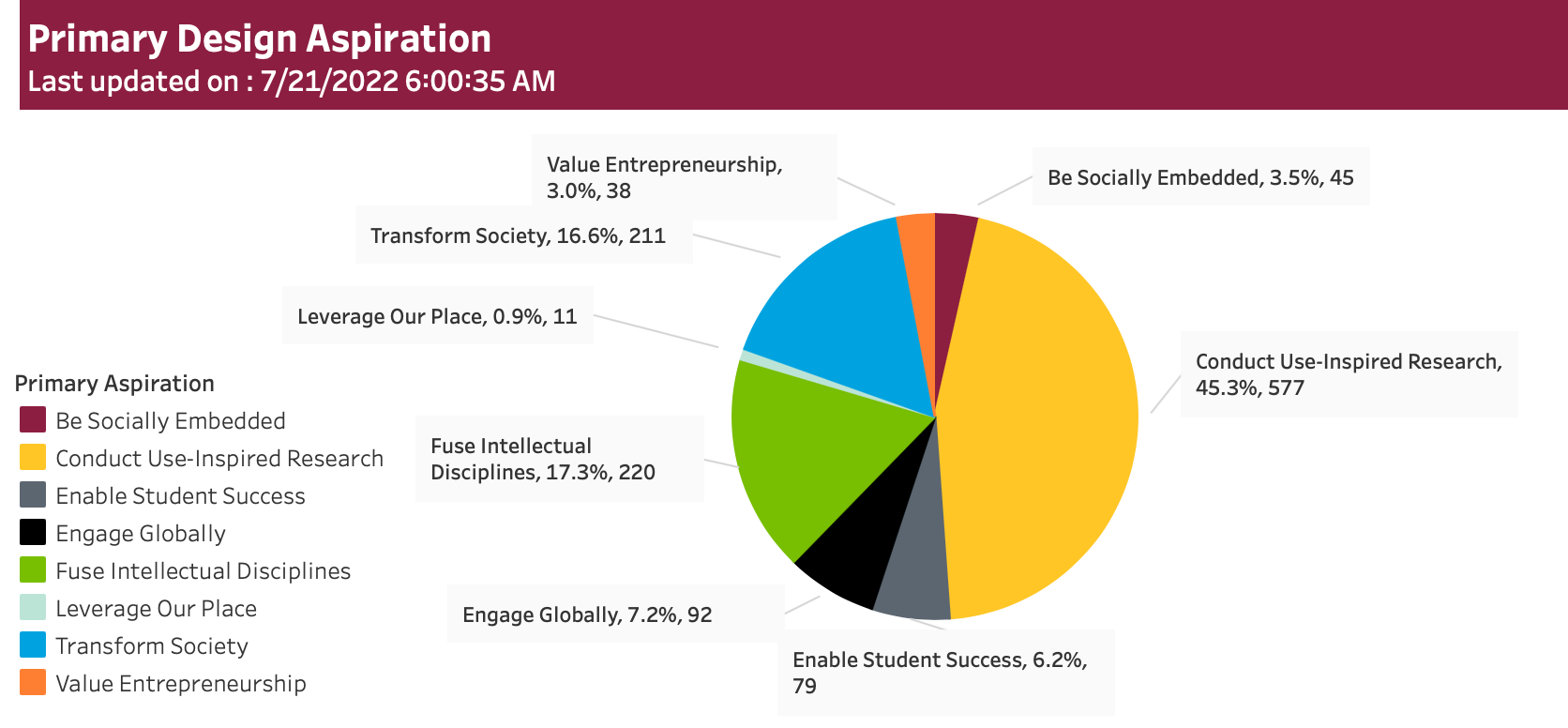
Looking at the pie chart, we see that more than 45% of the respondents say that their graduate research was based on “Conduct Use-Inspired Research,“ meaning, their research has purpose and impact. This is followed by “Transform Society” and “Fuse Intellectual Disciplines” at around 17%. These responses suggest that students believe they are part of catalyzing change in society and doing so within the interdisciplinary structures of ASU. (Source: ASU iPOS. Data was collected from 1,189 respondents between January 2021 and July 2022).
These answers are consistent with my observations of prospective and current students. One of the answers I hear when I ask “Why do you want to go to graduate school?” and “Why ASU?” is about the need to develop higher-level skills to solve challenging problems, and that ASU offers such an opportunity.
This way of thinking contrasts with my reasons for going to graduate school. I earned a master’s degree because I wanted job-based skills and I earned a PhD because the research job I wanted required it. The answers I hear now, although similar to mine, are stronger and focus more on solving societal-level problems.
Students today want to be active in making the world a better place – to transform society – and to do it with the skills and knowledge across multiple disciplines.
I’m inspired by this insight and wisdom.
Elizabeth A. Wentz
Vice Provost and Dean
Graduate College
More stories from the Graduate Insider

Graduate funding deadlines for Fall

Humanities Week: The Critical Language Scholarship
